About
Background
Infroton Fusion Inc., building on the pioneering and successful fusion experiments of the National Ignition Facility (USA) as well as its own innovative patents, has developed a unique technology: a magneto-inertial fusion (MIF) system driven by low-energy, kilojoule-class whispering-gallery-mode (WGM) lasers, supported by cavity pressure acceleration (CPA).
This technology operates using inexpensive and readily available deuterium fuel, and experimental evidence demonstrates its capability for stable, sustainable, and cost-effective energy production.
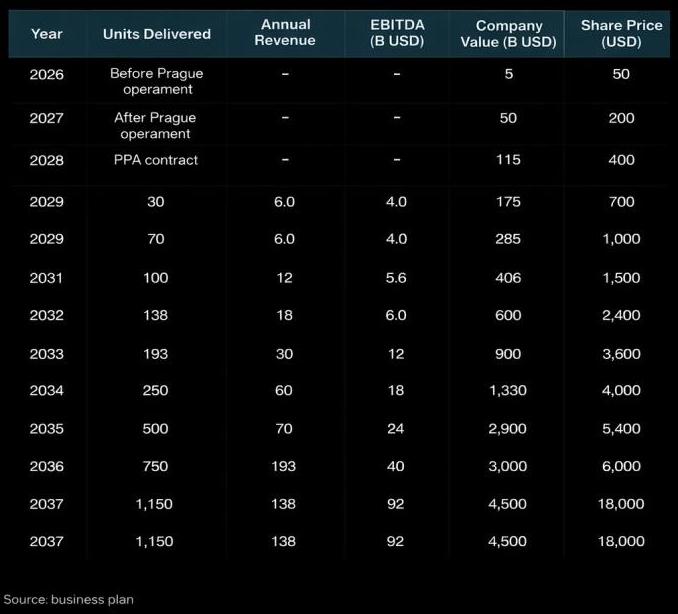
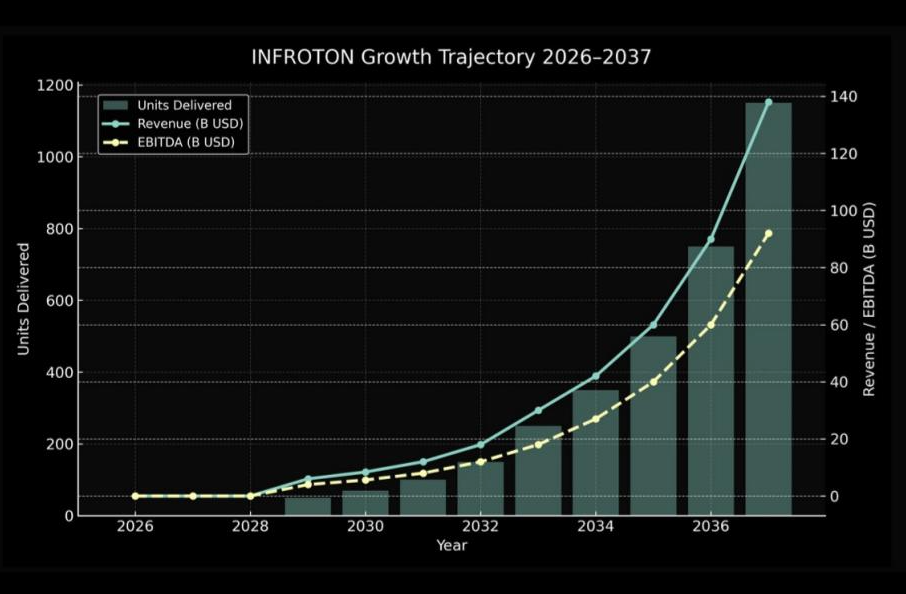
Infroton's goal is to ramp up production starting from 2030, reaching an annual output of 1,150 portable power plants by 2037 in the United States and Europe. Each unit will have a capacity of 36 MWe, capable of generating electricity at a cost of 6.5 USD/MWh, while also producing approximately 2.5 kg of strategic fusion material per year.
These power plants will be sold at a unit price of 120 million USD, primarily to global partners seeking independence from large-scale centralized grid infrastructures.
Our Vision
Clean, sustainable fusion energy everywhere, for everyone.
Our Mission
Protecting our planet and humanity with Infroton fusion energy.
Our Values
Together with our leading global partners, we have built an ecosystem that enables the production of affordable, clean electricity and tritium across the entire fusion value chain. We possess the technology, and the functionality of our patented inventions has been validated through successful laboratory experiments.
The Team
The INFROTON® project team consists of renowned physicists, data scientists, machine learning experts, software developers, and economists. Their work is supported by leading global partner companies.
Headquarters, Facilities
USA 320 Post Road, Suite 150 Darien, CT 06820
Hungary (EU): Infroton Fusion Hungary Kft, Wigner Research Centre, 1121 Budapest
Year Founded
2024
Technology
Magneto-inertial fusion (MIF) driven by low-energy, kJ-class whispering gallery mode (WGM) lasers supported by cavity pressure acceleration (CPA)
Fusion fuels: multiple configurations possible, including Deuterium (D) and Lithium Deuteride (LiD)
Energy conversion: helium-cooled ceramic pebble reactor converting thermal energy into electricity via Brayton-cycle turbines or thermophotovoltaic (TPV) cells
Tritium and Helium-3 Extraction
Infroton does not breed tritium like conventional approaches, nor does it rely on extracting trace (ppm-level) quantities of tritium from hundreds of tons of lithium-containing liquid metals or molten salts using complex and costly technologies.
Instead, we apply a simplified approach based on D–D fusion, where tritium and helium-3 are generated as reaction products and are present at significantly higher concentrations (approximately 20–30%) in the post-reaction gas mixture, enabling a much more straightforward extraction pathway.
Product
35 (+1) MWe fusion power plant module
By 2037:
Electricity production scaled to: 1,150 modules/year x 35 MWe x 90% = 317 million MWh/year = 0.31 PWh electricity (~1% of global energy production)
Tritium production scaled to: 1,150 x 2.5 kg/year = 2,875 kg (sufficient to supply 15 x 300 MW D-T fusion power plants)
Primary Target Markets
EU: 3 PWh
US: 4 PWh
Global: 30 PWh
Employees (Planned)
| Category | Headcount | Gross Annual / Person | Employer Benefits (25%) | Total Employer Cost / Year |
|---|---|---|---|---|
| Senior Executives | 10 | $640,000 | $1,600,000 | $8,000,000 |
| Middle Management | 150 | $225,000 | $8,437,500 | $42,187,500 |
| R&D / Engineers | 200 | $172,500 | $8,625,000 | $43,125,000 |
| Admin / Back-office | 40 | $88,000 | $880,000 | $4,400,000 |
| Factory & Service Workers | 2,100 | $86,400 | $45,360,000 | $226,800,000 |
| TOTAL | 2,500 | - | $64,902,500 | $324,512,500 |
Infroton - Global Partner Ecosystem
Infroton brings together world-leading partners across the full fusion value chain—from ignition to energy generation and fuel production.
Target Fabrication
- General Atomics (US) • Georgia Tech (US) • Cambridge Isotope Laboratories (UK)
- XRnanotech (CH) • Exaddon (CH) • Nanoscribe (DE) • Wigner Research Centre (HU)
Laser Systems
- Hamamatsu Photonics (JP) • Dipol Laser Systems (UK) • Coherent (US)
- Laserlab Europe (EU) • Wigner (HU)
Reactor Technology
- Blykalla (SE) • Wigner (HU)
Energy Conversion
- Antora Energy (TPV, US) • HolosGen (Brayton, US) • Wigner (HU)
Tritium Extraction
- ENI - H3AT (IT/UK) • Fusion Fuel Cycles (JP) • Tyne (US)
Go-to-Market & Strategic Sectors
- ICT LIONS (US) • Lockheed Martin (US)
Development Milestones
CLEAR PATH TO MARKET FOR FUSION ENERGY
- 2026 — SCIENCE: Validation of scalable fusion fuel targets
- 2027 — FINANCING: Securing early electricity and tritium off-take agreements
- 2028 — ENGINEERING: Construction of the first Infroton containerized power plant Launch of the first Infroton gigafactory with partners
- 2030-2037 — SCALING: Mass production, sales, and service
- 1,150 units installed annually
- $139 billion annual revenue
- 3,000 kg annual tritium production
Company Valuation
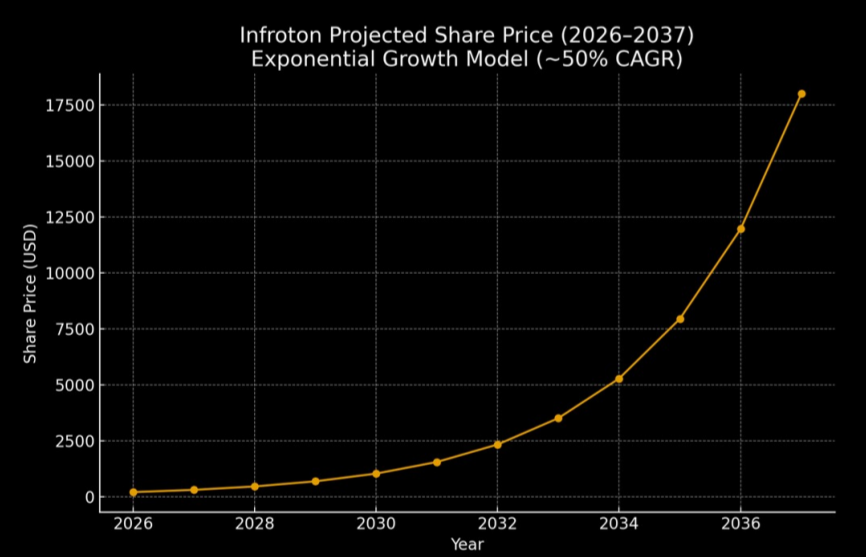
2026 valuation (based on patents and benchmarking): Infroton Inc. is estimated at $5 billion, based on expected EBITDA and comparative analysis with industry competitors such as Helion Energy and TAE Technologies. This reflects the strategic importance and commercial potential of its patented technologies in clean energy generation.
2037 projected valuation: $4,5 trillion, based on a 50x EBITDA multiple applied to an expected $92 billion EBITDA
Market Entry Model
Our power plants can be deployed anywhere in the world.
Target markets (first wave):
- AI data centers
- Industrial users
- Hydrogen production
- Remote / defense systems
Unlimited demand. The only limit is manufacturing.
Due to the exceptionally low electricity generation cost of 6.5 USD/MWh, the only significant constraint on sales is production capacity.
Gigafactory-based production
- Manufacturing in the USA + Europe
- 1,150 reactors/year
- Mass production similar to the EV industry
Dual revenue model: energy + tritium Each reactor simultaneously functions as:
- A power plant (35 MWe)
- A tritium production unit (2.5 kg/year)
Early customer incentives
Partners who purchase under reactor, electricity, or tritium off-take agreements may participate in Infroton's share program, allowing them to directly benefit from the company's financial growth.
Factories, service infrastructure, maintenance, and the network of remotely operated power plants will be controlled and optimized by artificial intelligence.
Artificial intelligence will dynamically adjust energy production throughout the day according to local demand conditions, enabling flexible, real-time supply for both small-scale and large industrial consumers.
Competitive Advantage
Tradititional Fusion
- Stadium-sized, MJ-energy laser systems
- Scarce, expensive, tritium-dependent fuel
- Centralized, giga-scale infrastructure
- Multi-decade timelines for commercial deployment
Infroton
- Containerized, modular fusion reactors
- kJ-class laser ignition (vs. MJ systems)
- Abundantly available, low-cost deuterium fuel
- Dual output: electricity + tritium fusion fuel
- Scalable mass production with market entry within three years
Financial Forecast